

Our surgeons regularly share valuable medical information, tips, and the latest advancements in surgical care.
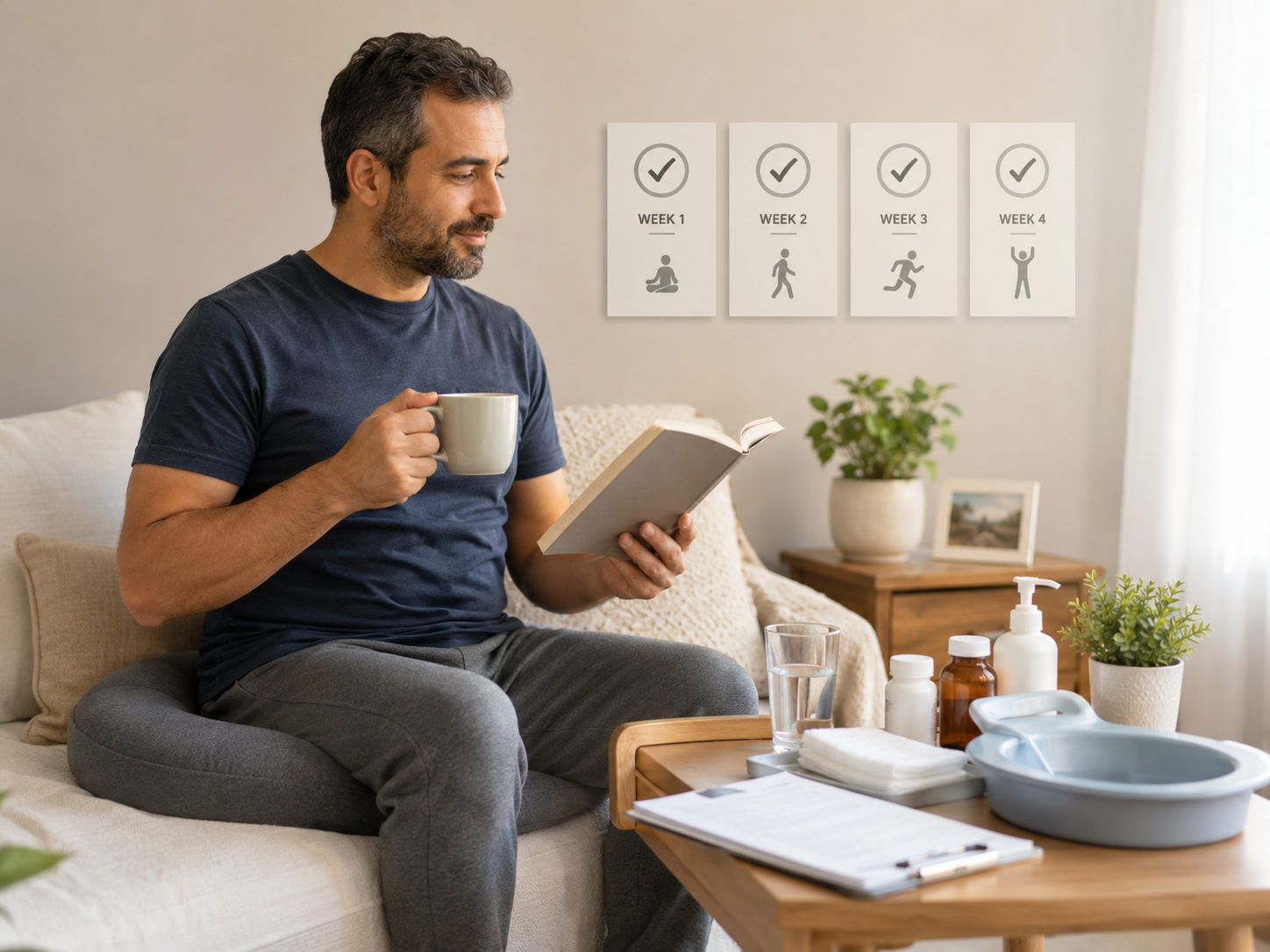
Most patients we meet for anal fistula surgery don't really care about the surgical technique. They care about one thing: how long until I feel like myself again?
That's a fair question, and the honest answer is that recovery from fistula surgery is more involved than most people expect — but also more predictable. The wound is small. The healing is steady. And almost everything you'll feel in the first six weeks falls into a normal range that we've walked thousands of patients through.
This guide is the conversation we'd have with you in the consultation room if we had an extra hour. It covers what to do before surgery, what the first 48 hours actually feel like, how each week tends to unfold, and the specific symptoms that warrant a call to your surgeon. None of it replaces the personalized instructions you'll get after your procedure — but it should remove a lot of the unknown.
The work that happens in the seven days before surgery has an outsized effect on your recovery.
Depending on the procedure, you may be asked to do a light bowel prep — usually a clear-liquid diet the day before and a single enema or laxative the morning of. The goal isn't a full colonoscopy-style cleanout; it's just to keep things quiet for the first day or two after surgery.
Stop blood-thinning medications (aspirin, ibuprofen, fish oil, certain supplements) on the schedule your surgeon gives you — typically 5–7 days out. If you take a prescription anticoagulant for a heart condition, do not stop it without talking to the prescribing physician first.
Buy these before surgery, because you won't want to be at the pharmacy on day one:
Plan for at least 5–7 days off for desk work, 10–14 for jobs that involve standing or lifting. We'll write a note.
You'll go home the same day. Most fistula procedures are outpatient and take 30 to 60 minutes under anesthesia.
The first sensation as the local anesthetic wears off is usually pressure and a dull burning rather than sharp pain. The pain peaks around hour 6 to 12, which is why we send you home with a prescription pain plan. Take the medications on schedule for the first two days — don't wait for pain to climb before treating it.
If you had a seton placed (a small drainage thread looped through the fistula tract), or if your wound was left open to heal from the inside out, you'll see pinkish, slightly bloody discharge on the gauze for several days. This is the wound doing its job. We'd be more concerned by no drainage than by some.
Almost everyone dreads it. The reality is rarely as bad as the anticipation. Start stool softeners the night of surgery and take the first dose of fiber the next morning. Most patients have their first bowel movement on day 2 or 3, and it's uncomfortable but tolerable. Doing it in a warm sitz bath — yes, in the water — can take the edge off if needed.
This is the week to do less than you think you need to. Working from the couch is fine. Walking to the kitchen is fine. Going to the grocery store is not.
Sitz baths become the center of your day. Soak in 3–4 inches of plain warm water for 10–15 minutes, three times a day and after every bowel movement. No epsom salts, no essential oils, no bubble bath — just warm tap water. The sitz bath relaxes the sphincter muscles, cleans the wound, and is the single most effective thing you can do for pain.
Hygiene. Don't wipe. Rinse with a squeeze bottle or take a quick shower after each bowel movement, then pat dry with a soft towel or use a hair dryer on cool.
Pain trajectory. Day-to-day pain typically drops by 30–50% between day 3 and day 7. By the end of week one, most patients are off prescription pain medication and managing with Tylenol.
By week two, you'll feel substantially better but you're not healed. The skin closes from the inside out, and what looks fine on the surface can still be tender underneath.
If a seton was placed, it stays in for weeks to months depending on the complexity of your fistula. It looks alarming the first time you see it in the mirror; it shouldn't hurt by week 2. You can shower, sit, and work normally with it in place. We'll remove or exchange it at follow-up visits.
By week four, most simple fistulotomies are essentially healed. Complex fistulas — multi-tract, Crohn's-related, or recurrent — take longer, sometimes 8–12 weeks to fully close.
You'll have a follow-up appointment around the 4-week mark. We'll look at the wound, check sphincter tone, and talk about returning to higher-impact exercise. Most patients are cleared for full activity (running, weightlifting, sex, swimming) somewhere between week 4 and week 8.
The most common complaint at this stage isn't pain — it's mild itching as the wound granulates and closes. That's healing, not a problem. Keep up the sitz baths once a day for another two weeks.
Recovery is predictable, but it isn't perfectly smooth, and a few symptoms warrant a phone call. Call our office if you have:
These don't always mean something is wrong — but they're the symptoms we want to evaluate rather than wait on.
Even with excellent surgical technique, anal fistulas can come back. The recurrence rate depends heavily on the type of fistula and the procedure used; we'll walk you through the specific numbers for your situation at your consultation. The single biggest predictor of long-term success isn't the surgery itself — it's identifying and treating the underlying cause, especially if Crohn's disease is involved.
If you've had a fistula recur, that's not a personal failure or a bad outcome. It's the disease behaving like the disease. We see it often, and we treat it with a different strategy the second time around.
Anal fistula recovery is six weeks of small disciplines: sitz baths three times a day, stool softeners every morning, walking but not pushing, and trusting the wound to do its work from the inside out. Most patients are back at a desk within a week and back to the gym within a month.
If you're scheduled for fistula surgery — or you're trying to decide whether to have it — we'd rather answer your specific questions in person than have you piece together an answer online. That's what consultations are for.
Related articles from the same topic


